
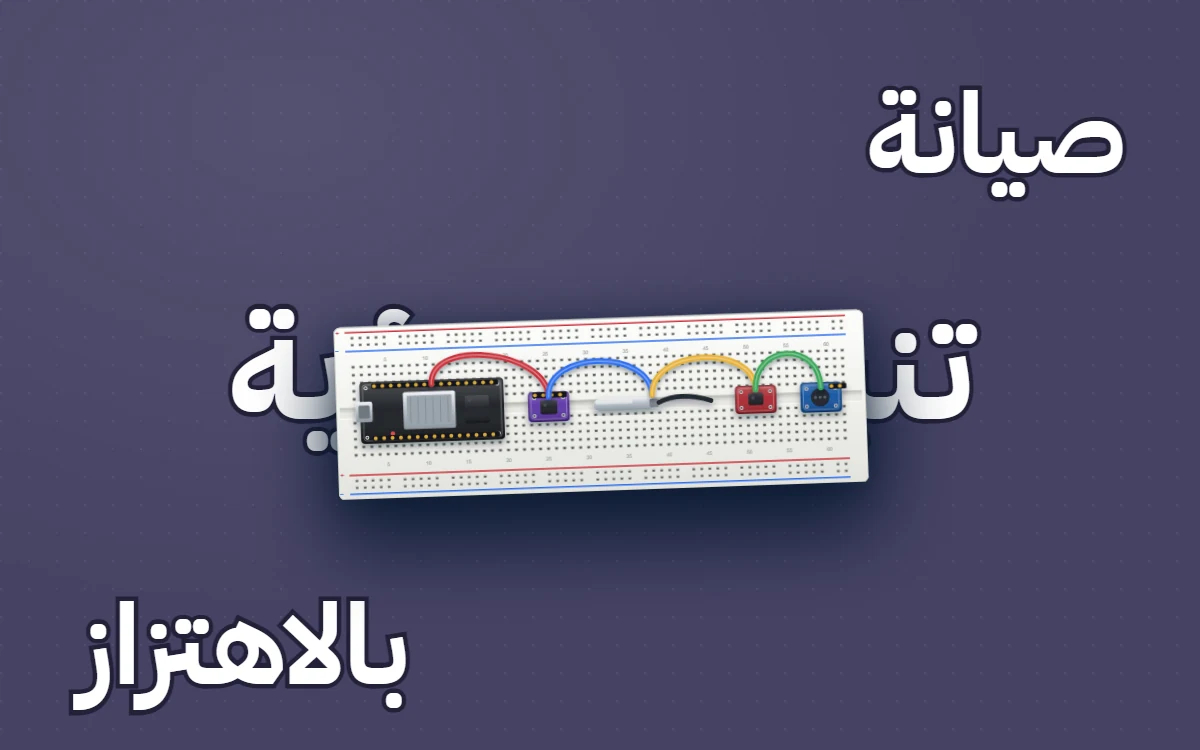
Predictive maintenance with vibration analysis
The system learns the motor's vibration fingerprint while healthy and alerts when it changes, since every mechanical fault shows up in vibration before the motor stops.
The problem
In factories a motor stops suddenly and the whole production line stops with it; the loss isn't the part's price but the hours of downtime. Calendar-based maintenance replaces healthy parts and misses parts about to fail. Vibration changes weeks before a fault, but it's usually only noticed when it becomes audible — too late.
How it works
- LearningThe system records the motor's vibration fingerprint while healthy as a reference.
- MonitoringThe accelerometer reads vibration at a high rate continuously.
- AnalysisFrequency analysis breaks the vibration into its components, since each fault has its own frequency.
- ComparisonA new frequency or a rise in intensity indicates a change in the motor's condition.
- TemperatureThe motor temperature reading supports the diagnosis, since friction generates heat.
- PredictionThe system estimates the time left before failure and issues a maintenance alert.
Project features
- Predicting a fault weeks before it happens — a direct, calculable financial value.
- Frequency analysis identifies the type of fault, not just its presence.
- It replaces calendar-based maintenance with condition-based maintenance.
- It reflects a deep understanding of signal processing, which makes the project stand out to the committee.
- It can expand to monitor several motors on a production line.
Parts
All the parts you need in one place. Remove what you already have, and swap parts to fit your budget. Parts with a photo are available in our store at their current price.
Prices are estimates and may change. Parts marked “other supplier” are ordered outside our main store.
Expected challenges
These are the main obstacles to expect during the build, laid out clearly so you know them before you start.
- The sampling rate must be high, or important frequencies are lost.
- How the sensor is mounted on the motor changes the reading completely: loose mounting adds noise.
- Each motor has a different fingerprint, so no single threshold fits all motors.
- Vibration from neighboring motors interferes with the reading.
- High heat near the motor affects the electronics themselves.
The consultation gives you a solution for each one.
Expected committee questions
Prepare your answers in advance: these questions come up often in defenses of similar projects.
- How does the system learn a healthy motor's vibration fingerprint?
- What role does the Fast Fourier Transform (FFT) play in vibration analysis?
- How is a bearing fault told apart from imbalance or looseness?
- How far ahead can the system predict a fault before it happens?
Similar projects
Projects close to this one in idea or parts. Check the differences before deciding, and borrow ideas you can add to your own project.
Students' experiences
Add a comment on the idea: +2 points. Or share your experience with photos of your build: +10 points. Every 50 points become a JD 5 discount voucher on parts orders.
Need solutions to the challenges and a complete technical path?
In the consultation we give you a solution for each challenge above, plus a practical build plan from the first step to the last: technologies, libraries, wiring diagram, timeline, and tips for the defense.
- Consultation session
- PDF with solutions and a plan
- 20 د.أ فقط