
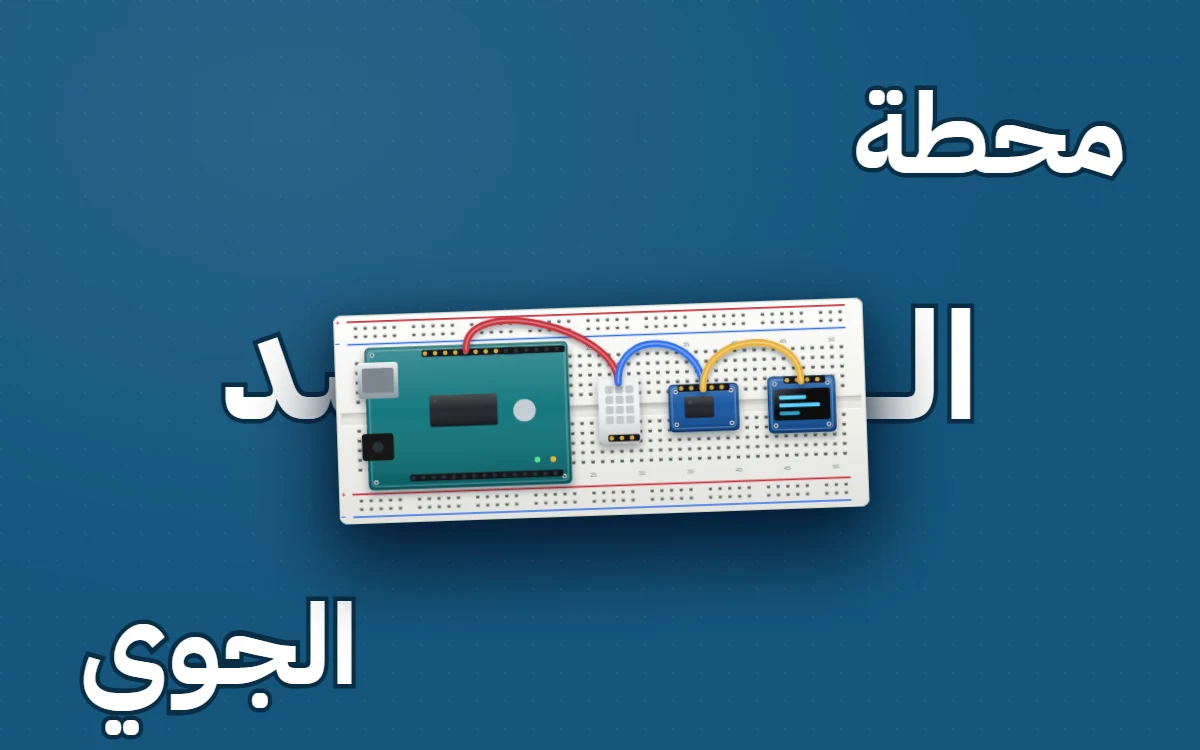
Local weather station
The station measures air temperature, humidity, pressure, and light, detects rain, and streams the readings live, showing the weather at the user's exact location rather than a city average.
The problem
Weather apps show readings from a station that may be kilometers away, while the difference between two neighborhoods in Amman can be several degrees. A farmer in the Jordan Valley or a herder in the Badia needs readings from their own land, not the airport's. Official weather stations are few and far apart. A low-cost local station fills that gap, and dozens of them can form a real monitoring network.
How it works
- MeasurementThe sensors read temperature, humidity, air pressure, and light.
- Rain detectionThe rain sensor detects falling drops and their intensity.
- ProcessingThe controller calculates averages and discards outliers.
- Local displayThe station's screen shows the current readings.
- BroadcastReadings are uploaded to a web dashboard every minute.
- LoggingDaily and monthly curves show the weather's trend, not just the current reading.
Project features
- One of the easiest projects on the list to build, and a good fit when time is very short.
- Real local data instead of estimates from a distant station.
- It can expand into a network of stations, since each unit is cheap.
- The historical curves give the project depth beyond showing a single value.
- A solid foundation for more complex agricultural and environmental projects.
 Preparing the interactive model…
Part models from the libraries KiCad andEspressif (CC-BY-SA 4.0), lighting from Poly Haven. Click any part's name to zoom in on it.
Parts
All the parts you need in one place. Remove what you already have, and swap parts to fit your budget. Parts with a photo are available in our store at their current price.
Prices are estimates and may change. Parts marked “other supplier” are ordered outside our main store.
Expected challenges
These are the main obstacles to expect during the build, laid out clearly so you know them before you start.
- Sensor placement: direct sunlight raises the temperature reading by several degrees.
- Protecting the electronics from rain while keeping the sensors exposed to the air.
- The rain sensor corrodes over time through oxidation.
- Securing power at an exposed site far from the grid.
- Calibrating the readings against a reliable reference station.
The consultation gives you a solution for each one.
Expected committee questions
Prepare your answers in advance: these questions come up often in defenses of similar projects.
- How are the sensors protected from direct sunlight and rain without affecting the reading?
- How is altitude calculated or the weather forecast from air pressure?
- How were the readings compared with the official weather station's?
- What is the reading rate, and why was it chosen?
Students' experiences
Add a comment on the idea: +2 points. Or share your experience with photos of your build: +10 points. Every 50 points become a JD 5 discount voucher on parts orders.
Need solutions to the challenges and a complete technical path?
In the consultation we give you a solution for each challenge above, plus a practical build plan from the first step to the last: technologies, libraries, wiring diagram, timeline, and tips for the defense.
- Consultation session
- PDF with solutions and a plan
- 20 د.أ فقط